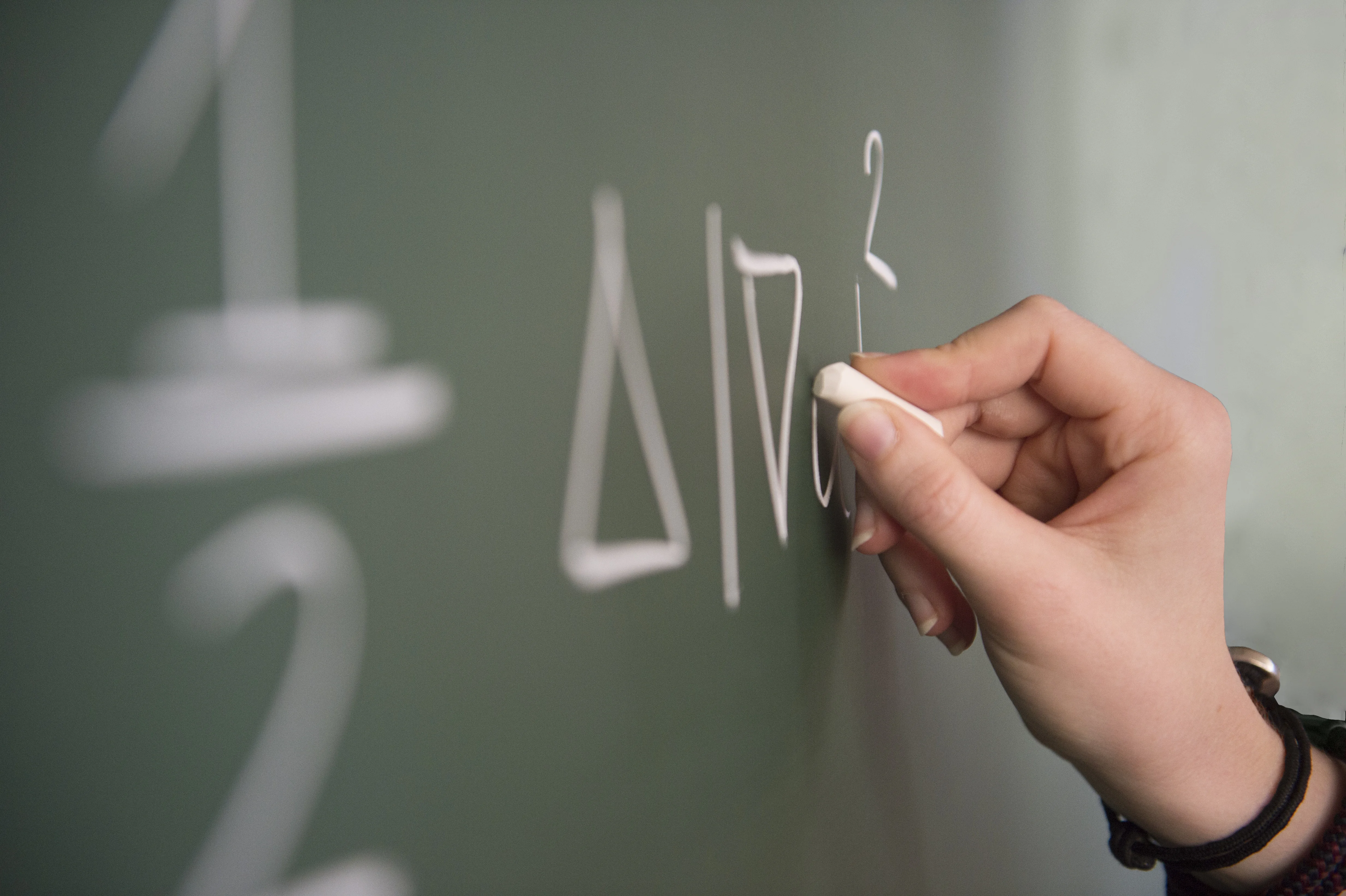
A photo of a series of Bose-Einstein condensate solitons courtesy of the American Institute of Physics website and a team at Rice University.
Topic
We will host a five day workshop on nonlinear dispersive
equations. Specifically, we will look at existence, description,
stability and scattering results for phenomenological objects
resulting from nonlinear effects in dispersive PDE. Such objects
include solitons, blow-up profiles, breathers, as well as other
interesting objects existing for long times in the dynamics of
an equation. Topics ranging from analytical descriptions to
numerical simulations and asymptotics are all welcome aspects
to the workshop.
Confirmed Participants
Ramona Anton (University of Paris-Sud, XI)
Marius Beceanu (University of Chicago)
Nicolas Burq (University of Paris-Sud)
Adrian Constantin (University of Vienna)
Joachim Escher (University of Hannover)
Gadi Fibich (Tel Aviv University)
Axel Grünrock (University of Bonn)
Justin Holmer (Brown University)
Oana Ivanovici (University of Paris-Sud)
Markus Kunze (University of Duisburg-Essen)
Yvan Martel (University of Versailles-Saint-Quentin-en-Yvelines)
Luc Molinet (University of Paris-Nord)
Fabrice Planchon (University of Paris 13)
Jean-Claude Saut (University of Paris-Sud)
Daniel Tataru (University of California, Berkeley)
Nikolay Tzvetkov (University of Lille)
Erik Wahlen (Lund University)
Gang Zhou (ETH - Zurich)
Maciej Zworski (University of California, Berkeley)
Conference Location and Schedule
The talks will take place at Wegelerstrasse
10 at the Applied Mathematics Institute in Bonn. The official
arrival date for the conference is March 1st, 2009 and the
departure date is March 7th, 2009. Registration will begin at
9 AM on Monday, March 2nd, 2009.
Monday:
9:00 AM - 9:30 AM: Registration
9:30 AM - 10:30 AM: Nicolas Burq
10:30 AM - 11:00 AM: Coffee
11:00 AM - 12:00 PM: Axel Grünrock
12:00 PM - 2:30 PM: Lunch/Afternoon Break
2:30 PM - 3:30 PM: Luc Molinet
3:30 PM - 4:30 PM: Adrian Constantin /li>
Tuesday:
9:30 AM - 10:30 AM: Nikolay Tzvetkov
10:30 AM - 11:00 AM: Coffee
11:00 AM - 12:00 PM: Yvan Martel
12:00 PM - 2:30 PM: Lunch/Afternoon Break
2:30 PM - 3:30 PM: Daniel Tataru
3:30 PM - 4:30 PM: Gadi Fibich
Wednesday:
9:00 AM - 10:00 AM: Jean-Claude Saut
10:00 AM - 11:00 AM: Erik Wahlen
11:00 AM - 11:30 AM: Coffee
11:30 AM - 12:30 PM: Joachim Escher
12:00 PM - 2:30 PM: Lunch/Afternoon Break
2:30 PM - 5:30 PM: Excursion in Bonn
6:00 PM - 9:00 PM: Conference Party at Herbert Koch's House
Thursday:
9:30 AM - 10:30 AM: Oana Ivanovici
10:30 AM - 11:00 AM: Coffee
11:00 AM - 12:00 PM: Markus Kunze
12:00 PM - 2:30 PM: Lunch/Afternoon Break
2:30 PM - 3:30 PM: Fabrice Planchon
3:30 PM - 6:00 PM: Afternoon Break
6:00 PM - 7:00 PM: Justin Holmer in Intercontinental Video Seminar
Friday:
9:30 AM - 10:30 AM: Gang Zhou
10:30 AM - 11:00 AM: Coffee
11:00 AM - 12:00 PM: Marius Beceanu
12:00 PM - 2:30 PM: Lunch/Afternoon Break
2:30 PM - 3:30 PM: Ramona Anton
Talk Abstracts
Ramona Anton
Title: Global existence for
Gross-Pitaevskii equation on three dimensional
exterior domains
Abstract: We prove global existence in
the energy space for the Gross-Pitaevskii
equation on exterior domains of dimension
three. We use a Strichartz estimate
adapted to the domain. This estimate
follows from a semi-classical dispersive
estimate combined with a smoothing
effect.
Marius Beceanu
Title: A center-stable manifold in ^{1/2}$ for the ^{1/2}$ critical NLS
Title: Global conservative and global dissipative
solutions to the Camassa-Holm equation
Abstract:
The Camassa-Holm equation is a nonlinearly dispersive
model equation for the propagation of waves in shallow
water. The equation can be written in the form of a
scalar conservation law plus an integral source term that
preserves the H^1 norm of the solution. Smooth initial
data can lose regularity in finite time in the form of
breaking waves (the solution remains bounded but its
slope becomes unbounded in finite time). We present
a method for constructing a continuous semigroup
of global conservative solutions. By introducing
a new set of independent and dependent variables,
the equation is transformed into a semilinear system,
whose global solutions are obtained as fixed points
of a contractive transformation. These new variables
resolve all singularities due to possible wave breaking.
Returning to the original variables, we obtain a
semigroup of global solutions, depending continuously
on initial data. These solutions are conservative,
in the sense that the total energy equals a constant,
for almost every time. A modification of the approach
by considering a semilinear hyperbolic system with a
non-local source term which is discontinuous but has
bounded directional variation permits the construction
of global dissipative solutions, ensuring that energy
loss occurs only through wave breaking. This is joint
work with A. Bressan.
Joachim Escher
Title: Wave breaking and shock waves for the periodic Degasperis-Procesi Equation
Abstract: The Degasperis-Procesi equation is a
recently derived shallow water wave equation, which is
- similar as the Camassa-Holm equation - embedded in
a family of spatially periodic third order dispersive
conservation laws. The coexistence of globally in time
defined classical solutions, wave breaking solutions,
and spatially periodic peakons and shock waves is
evidenced in the talk, and the precise blow-up scenario,
including blow-up rates and blow-up sets, is discussed in
detail. Finally several conditions on the initial profile
are presented, which ensure the occurence of a breaking
wave. This is joint work with Zhaoyang Yin.
Gadi Fibich
Title: Collapsing vortex solutions and the NGO method
Abstract: In the first part of this talk I will present
some recent results on singular vortex solutions of the
Nonlinear Schrödinger equation (NLS). These solutions
have the unique property that they vanish identically
at the singularity.
In the second part of this talk I will present a
novel Nonlinear Geometrical Optics (NGO) method that
predicts the self-focusing dynamics of high-power
solutions of the NLS.
Justin Holmer
Title: Effective dynamics for KdV type equations
Markus Kunze
Title: Global asymptotic stability for a rotating
charged sphere in the Abraham model
Abstract:
The Abraham model can be used to describe the dynamics
of a classical charged particle under the influence of
its self-generated Maxwell fields. If the particle is
fixed at the origin, then the dynamical quantities are the
angular velocity and the fields. For a charged sphere,
it is shown that every solution approaches the set of
stationary solutions in the long-time limit. Since for
this particular charge model the usual non-resonance
condition ("Wiener condition") is violated, it is much
harder to exploit the dispersive mechanism induced by
the local energy decay.
Yvan Martel
Title: Collision of solitons for the generalized KdV equations
Luc Molinet
Title: Global attractor and asymptotic
smoothing effects for the weakly damped cubic
Schrödinger equation in L^2(T).
Abstract:
We prove that the weakly damped cubic Schrödinger
flow in
L^2(T) provides a dynamical system that possesses
a global attractor. The proof relies on a sharp
study of the behavior of the associated flow-map
with respect to the weak L^2(T)-convergence.
Co mbining the compactness if L^2 of the attractor
with the approach developed by O. Goubet we show
that the attractor is actually a compact set
of H^2(T). This asymptotic smoothing effect
is optimal in view of the regularity of the
steady states.
Daniel Tataru
Title: Concentration and dispersion in large data wave maps
Nikolay Tzvetkov
Title: Instability of line solitary water waves
Erik Wahlen
Title: Stability of solitary
water waves with weak surface
tension
Title: Equipartition of Energy in Nonlinear
Scrödinger/Gross-Pitaevskii Equations
Abstract: In this talk I will present the
recent result, joint with M. I. Weinstein,
on the mass transfer between neutral modes
and ground states of weakly nonlinear NLS.
Our result confirms rigorously what was observed
in physical experiments, in which it was ob
served that the ground states grow by half of
the mass of the neutral modes as the solution
reaches equilibrium.
Maciej Zworski
Title: Breathing patterns in nonlinear relaxation
Abstract: In numerical experiments involving
nonlinear solitary waves propagating through
nonhomogeneous media one observes "breathing"
in the sense of the amplitude of the wave going
up and down on a much faster time scale than the
motion of the wave. In this paper we investigate
this phenomenon in the simplest case of stationary
waves in which the evolution corresponds to
relaxation to a nonlinear ground state. The
particular model is the popular $\delta_0$
impurity in the cubic nonlinear Schrödinger
equation on the line. We give asymptotics of the
amplitude on a finite but relevant time interval
and show their remarkable agreement with numerical
experiments. We stress the nonlinear origin of the
"breathing patterns" caused by selection of the
ground state depending on the initial data, and
by the non-normality of the linearized operator
(joint work with Justin Holmer).
Accommodation
Hotel Deadline 28 January:
We have reserved blocks of rooms at the Hotel Krug and the Hotel Mozart
for all invitees who have responded that they will be attending. Please
send us your travel information by January 28th so that we may finalize
all reservations accordingly.
Hotel Krug
Sternenburgstrasse 15
53115 Bonn
Telefon: (0228) 22 58 68
Fax: (0228) 24 15 44
Email: hotel-krug@online.de
Website: www.hotelkrug.de
Travel Information
There will be full reimbursement of travel expenses
for all workshop invitees. Please fill out the HCM Travel Expense Form and attach your
travel receipts. You can either submit them during the workshop
or mail them in after your departure from Bonn.
Arriving from Colgone
The closest airport is Cologne/Bonn (CGN). The express
bus SB60 shuttles between the airport and Bonn city center
(ZOB). The ride takes approx. 30 minutes, and a one-way ticket
costs approx. Euro 7,-. For details see (German version) here.
English version: Here.
The bus terminal (ZOB) in Bonn is opposite the central railway
station (Hauptbahnhof) in the centre of town. If you are flying
into Frankfurt or Düsseldorf, we recommend taking a train from
the airport to Bonn Central station (Hauptbahnhof). There
are trains every hour (IC or EC trains) to Bonn. You can
check the schedules on the website of the German railway
company DB www.bahn.de
(remove the tick from the box: prefer fast connections!).
This website can be switched to English by clicking on
"Internat. Guests." If you take the ICE from Frankfurt to
Siegburg/Bonn, you then take tram 66 from Siegburg to Bonn. The
tram stop is just below the train platform (take the elevator)
in the same building. It is about a 15 minute tram ride to
Bonn. Map here
(Nordrhein-Westfalen>Bonn).
There will be a trip on Wednesday afternoon, March 4th, 2009
including a walk along the Rhine River and a visit to a local
historical/political site in Bonn. There will be a small cost
to participate.